
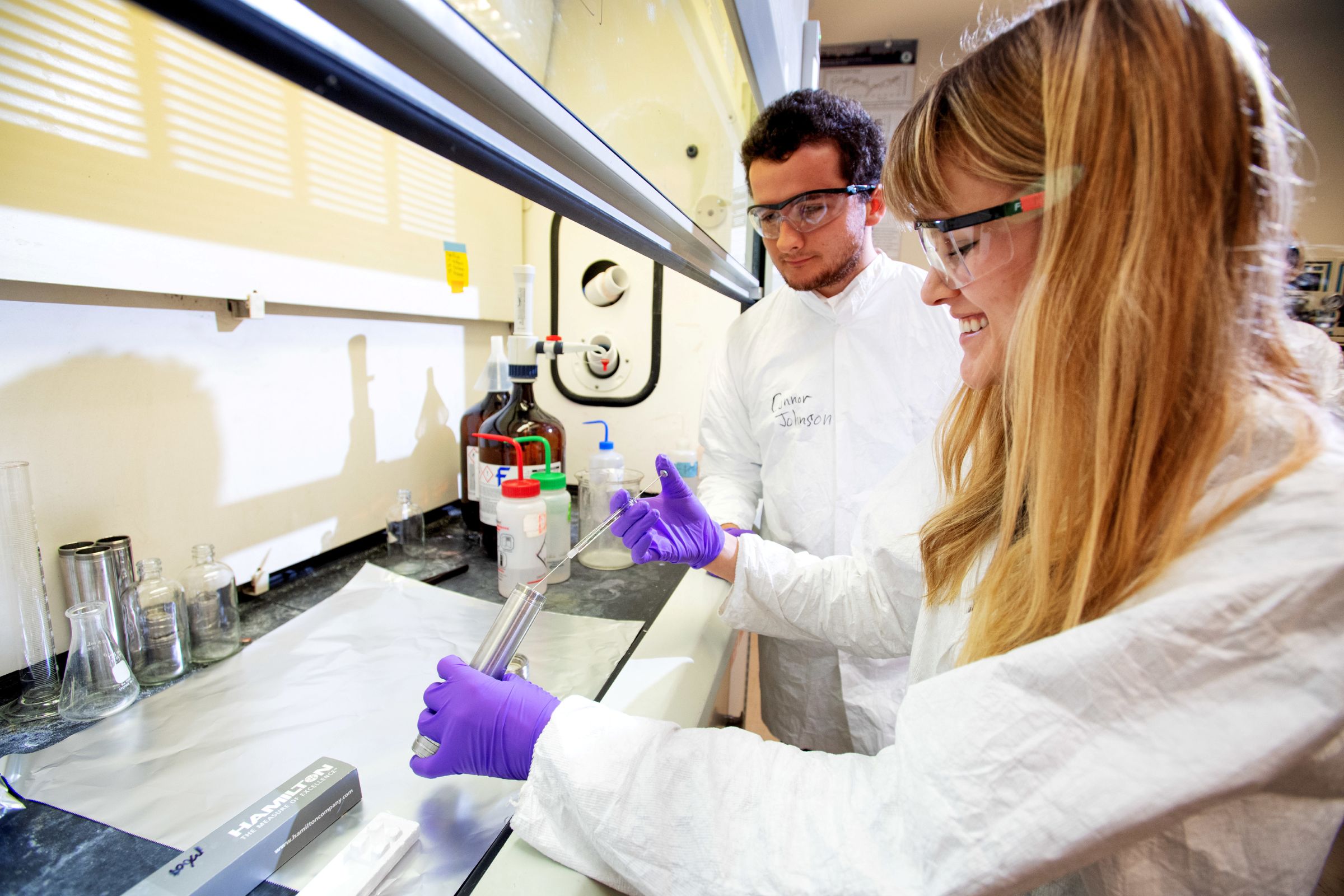
The Department of Civil and Environmental Engineering has two National Academy of Engineering members, Professors Jerry Schnoor and Witek Krajewski, among its ranks.
Our faculty are leaders and affiliates engaged in research at centers and institutes across campus.
Research areas
- Flood mitigation and prevention
- Watershed and nutrient management
- Hydroclimatology
- Hydroinformatics
- Water sustainability
- Emerging contaminants
- Groundwater cleanup
- Fate and transport of persistent organic pollutants
- Water and wastewater treatment and reuse
- Environmental biotechnology
- Nanotechnologies for water monitoring and treatment
- Water quality monitoring
- Structural health monitoring
- Optimization of structural and mechanical systems
- Surface transportation infrastructure
- Driver decision making
Research video highlights
Research centers affiliated with CEE

IIHR—Hydroscience and Engineering
IIHR—Hydroscience and Engineering is a world-renowned center for education, research, and public service focusing on hydraulic engineering and fluid mechanics. Based in the C. Maxwell Stanley Hydraulics Laboratory, a five-story red brick building on the banks of the Iowa River, IIHR is a unit of the University of Iowa’s College of Engineering. At IIHR, students, faculty members, and research engineers work together to understand and manage one of the world’s greatest resources—water. Students from around the world benefit from IIHR’s comprehensive multidisciplinary approach, which includes basic fluid mechanics, laboratory experimentation, and computational approaches.

Iowa Flood Center
The IFC is engaged in flood projects in several Iowa communities and employs several graduate and undergraduate students participating in flood-related research. The IFC strives to develop hydrologic models for physically-based flood frequency estimation and real-time forecasting of floods, including hydraulic models of flood plain inundation mapping; to establish community-based programs to improve flood monitoring and prediction along Iowa’s major waterways and to support ongoing flood research; to share resources and expertise of the Iowa Flood Center; to assist in the development of a workforce in the state knowledgeable regarding flood research, prediction, and mitigation strategies; to conduct the activities required by this chapter in cooperation with various state and federal agencies.

Iowa Technology Institute
The Iowa Technology Institute (ITI) conducts basic and applied research. The mission is to cultivate collaboration across disciplines, invent advanced technologies, and conduct trailblazing research in design, simulation, and experimentation that enables a safer and more productive future. ITI provides a unique environment for research and development for faculty, graduate and undergraduate students, research fellows, and professional scientists. ITI spans more than 20 laboratories and centers, with research focusing on flight testing, autonomous systems, advanced manufacturing and materials, human modeling and simulation, aerospace technology, biotechnology, environment, energy, systems, and sensors. Scientists conduct experiments in flight testing, human performance, robotics, biomedical and biochemical research, machine learning, smart sensors, remote sensing, renewable energy, and modeling of environmental change.

Iowa Superfund Research Program
The Iowa Superfund Research Program is a joint endeavor involving basic, mechanistic, and applied projects in biomedical and non-biomedical research areas. The program's overall theme is the consequences of atmospheric sources and exposures to semi-volatile polychlorinated biphenyls (PCBs), and it deals with volatilization, transport, and exposure of lower halogenated PCBs, especially those PCBs that are associated with contaminated waters, former industrial sites, other atmospheric sources, and the consequences of exposure to them. The ISRP brings together 15 scientists representing four colleges in Iowa, Illinois and Kentucky. Working together, they measure sources, transport, and environmental exposure of PCBs; their distribution, metabolism, and toxicity in animals and humans; and novel methods of phytoremediation.

Center for Health Effects of Environmental Contamination
The University of Iowa Center for Health Effects of Environmental Contamination (CHEEC) is a multidisciplinary environmental health research center dedicated to supporting and conducting research to identify, measure and prevent adverse health outcomes related to exposure to environmental toxins. CHEEC is comprised of faculty and researchers located in the University of Iowa Colleges of Public Health, Engineering, and Liberal Arts and Sciences, as wellas the State Hygienic Laboratory.

Center for Biocatalysis and Bioprocessing
The Center for Biocatalysis and Bioprocessing (CBB) combines first-class scientific faculty with cutting-edge facilities to reshape and define new technologies for chemical, pharmaceutical, nutritional, and agrochemical industries. Located at the University of Iowa Research Park, the CBB consists of more than 50 faculty members and 300 researchers, including graduate and undergraduate students, postdoctoral scientists, technicians, and visiting faculty and industrial scientists. Its faculty members come from eight different departments, and it is home to more than 20 predoctoral fellows. The principal areas of study within the CBB include biocatalyst fundamental properties, bioremediation, bioprocessing, new biocatalyst discovery, novel biocatalyst applications, biosensing technology, and reactive agent development.
Water Sustainability Initiative
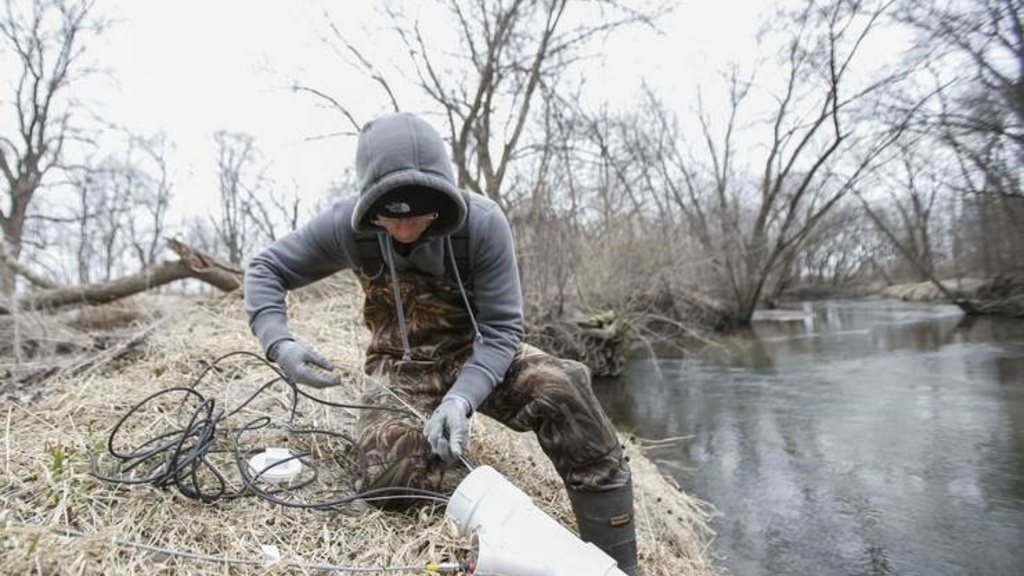
Motivated by one of 14 Grand Challenges from the National Academy of Engineering — "provide access to clean water" — the University has established a Water Sustainability Initiative (WSI) to advance research, education, and outreach on sustainability. The WSI expands existing strength at UI in interdisciplinary research on water including its availability, quality, reuse, health impacts, and its relationship to a changing climate. Economics, policy, and law as well as the natural sciences and engineering are all engaged to solve the problems of water. The faculty alliance on water sustainability encompasses the Colleges of Liberal Arts and Sciences, Public Health, Law, Engineering, the Graduate College, and the Public Policy Center. Among the various resources already developed to advance the initiative are the Iowa Flood Center, the UI Office of Sustainability, and the undergraduate Certificate in Sustainability.
Center for Global and Regional Environmental Research
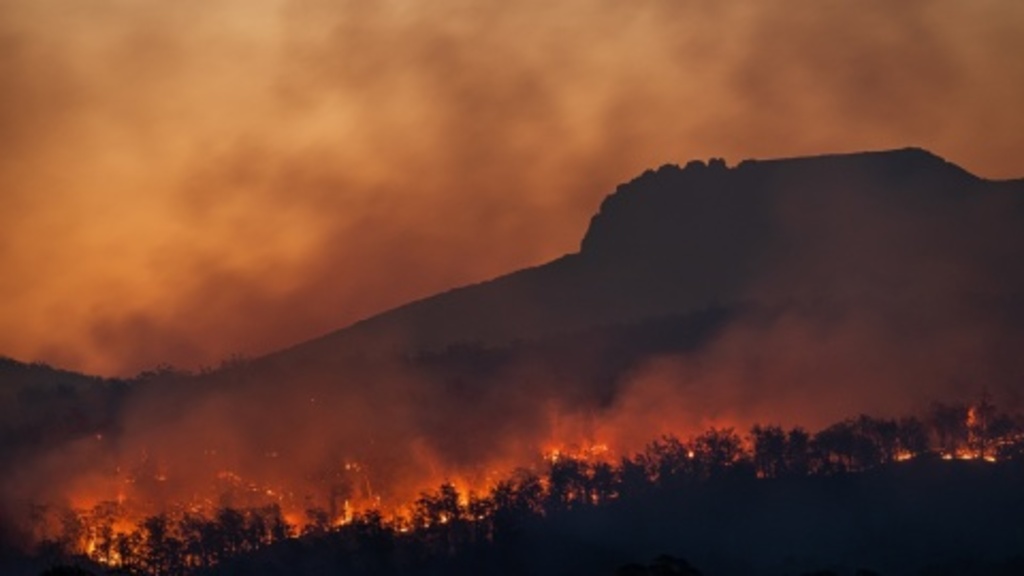
The Center for Global and Regional Environmental Research (CGRER) is a state-funded institute devoted to studying and bettering our environment. The center promotes interdisciplinary research on the many aspects of global environmental change. Areas of focus include regional effects on natural ecosystems, environments, and resources, and effects on human health, culture, and social systems. To accomplish its missions, CGRER awards seed grants, fosters interdisciplinary courses, provides state-of-the-art research facilities, and holds seminars and symposia. Through these activities, CGRER assists Iowa’s agencies, industries, politicians, and citizens as they prepare for accelerated environmental change.

Center for Social Science Innovation
The Center for Social Science Innovation (CSSI) is the University of Iowa’s only Iowa Board of Regents approved premier interdisciplinary social science research center. CSSI provides faculty, staff, students, and community members across the state of Iowa and beyond the resources and support they need to investigate the most important issues facing our society.