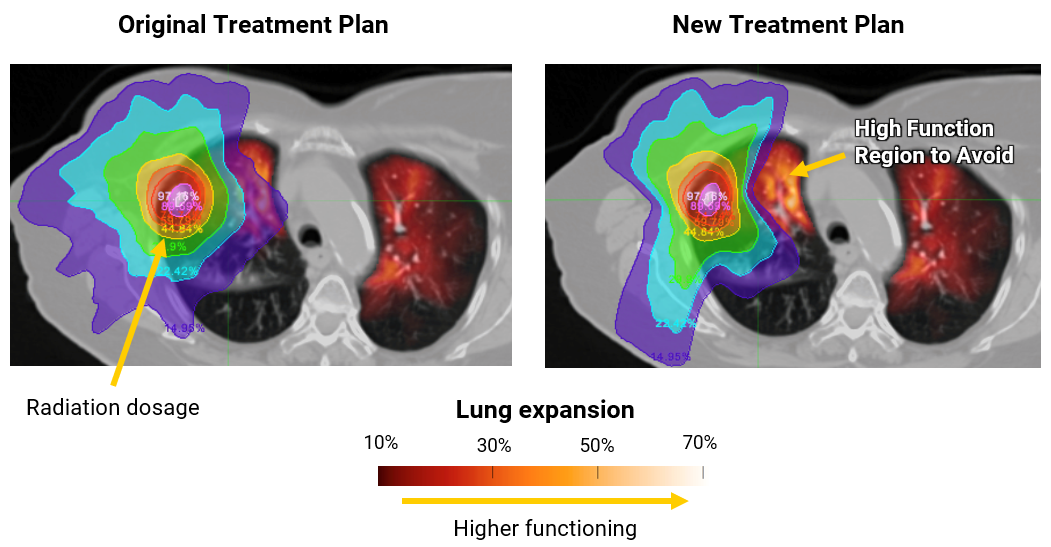
A new research study could help preserve lung function and improve the quality of life of lung cancer patients by making radiation treatments more precise and reducing damage to healthy lung tissue.
In a study funded by the National Institutes of Health, researchers at the University of Iowa and Oregon Health & Science University are working to better understand radiation-induced lung injury and identify ways to protect healthy lung tissue during treatment.
Traditionally, researchers have used CT imaging to evaluate how radiation affects airflow, or ventilation, in the lungs. The new study expands that approach by also measuring blood flow (perfusion). By combining both, researchers hope to get a more complete picture of how healthy lung tissue responds to radiation.
"This work will enable better characterization of injury to healthy lung tissue and inform strategies to reduce that injury while effectively treating the tumor," said Gary Christensen, chair of the Department of Electrical and Computer Engineering and a member of the research team.
The study will examine both direct damage to lung tissue that receives radiation and indirect damage that can occur when radiation affects the airways and blood vessels that supply other regions of the lung. Researchers will also investigate whether ventilation and perfusion changes are linked and which measure is most closely associated with long-term lung function and patient quality of life.
The findings may eventually allow clinicians to design radiation treatment plans that avoid the lung's highest-functioning regions whenever possible while still delivering effective doses to cancerous tissue.
The need is significant. Radiation-related lung injury can lead to inflammation, scarring, and reduced lung function, with moderate to severe side effects occurring in nearly one-third of surviving patients. Researchers hope the new approach will help establish dose thresholds that minimize those complications and provide new guidance for personalized treatment planning.
John Bayouth, formerly of the University of Iowa and now with Oregon Health and Science University School of Medicine, leads the study. The University of Iowa team consists of Christensen as lead principal investigator (PI) at Iowa; multi-PI Joseph Reinhardt, Roy J. Carver Chair in Biomedical Engineering; and Sarah Gerard, assistant professor of biomedical engineering. The Carver Charitable Trust also provided pilot funding to support this project.
"Our hope is that this research will help inform better treatment decisions and leave patients with better lung function after treatment," Gerard said. "Ultimately, that can translate into a higher quality of life for patients."