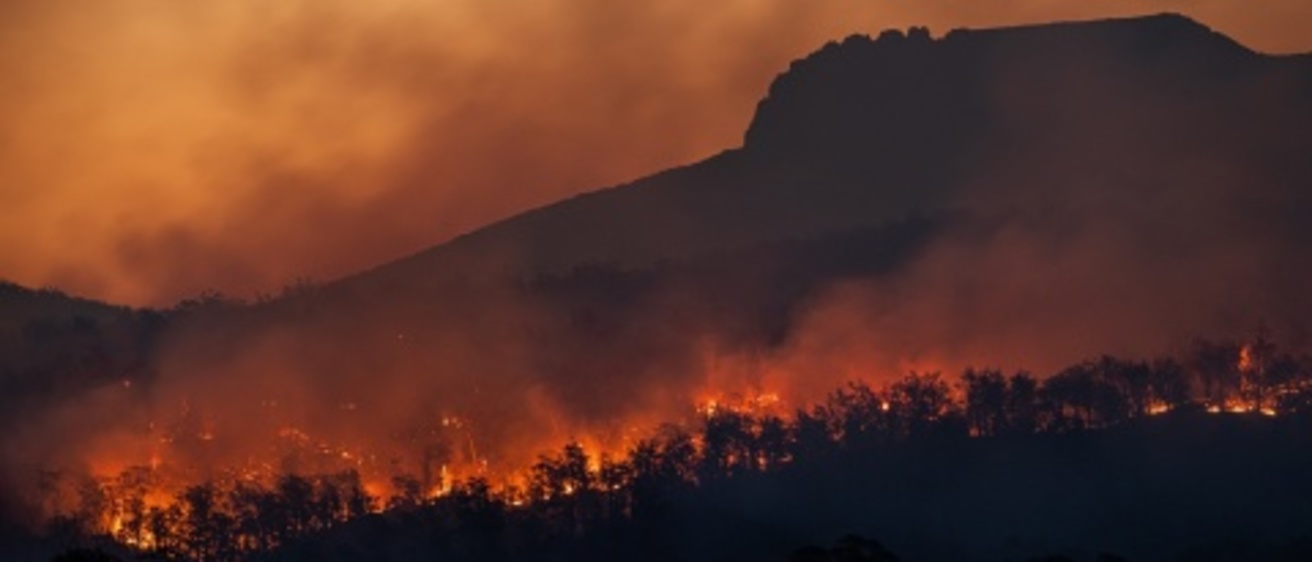
As wildfires grow more frequent, intense, and destructive across the United States, researchers at the University of Iowa (UI) have secured a National Science Foundation grant to study how fires behave after dark.
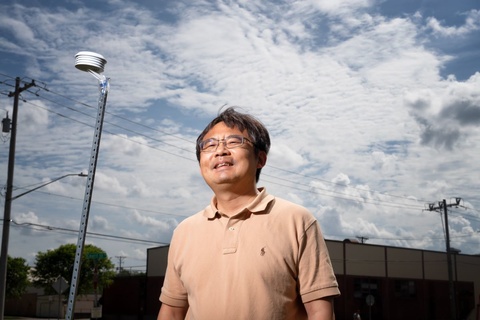
Led by co-principal investigator Jun Wang, the Lichtenberger Family Chair in Chemical and Biochemical Engineering and department executive officer of chemical and biochemical engineering, the FIRE-MODEL project seeks to improve predictions of wildfire growth and smoke emissions by collecting more accurate nighttime observations.
Communities, emergency responders, and public health officials could use these predictions to better prepare for fire-related risks.
Wildfires affect millions of Americans each year, both through their flames and the smoke and pollutants they release into the atmosphere. This hazard is expected to intensify in the coming decades.
Accurate forecasts of fire behavior and emissions are essential for protecting lives, improving air quality warnings, and guiding firefighting strategies. Yet scientists lack detailed information about how fires change over time and across large areas.
The project addresses this gap by combining observations from satellites, aircraft, and ground-based instruments to better understand the relationship between fire behavior and the pollutants fires emit. Researchers will focus on data from the Visible Infrared Imaging Radiometer Suite (VIIRS), a satellite instrument that can detect the intensity and location of active fires.
What makes this research innovative is its use of a measurement known as the Visible Energy Fraction (VEF). Scientists believe VEF can reveal whether a fire is burning with intense flames or smoldering more slowly, a distinction that strongly influences the amount and type of smoke produced.
“Flaming fires emit visible light, whereas smoldering fires do not,” said Wang, who also serves as associate director of the Iowa Technology Institute (ITI). “By using satellites to measure the intensity of visible light emitted from fires, we can better characterize the location of fire lines at night and understand fire emissions.”
Greater flaming combustion produces more carbon dioxide, a greenhouse gas, while more smoldering combustion produces more smoke, a major source of air pollution, Wang added.
The FIRE-MODEL team will leverage NightHawk, a tool developed with funding from the UI’s private-public partnership program, to test and validate these measurements during field campaigns in Montana.
The National Science Foundation is sponsoring the three-year, $2 million project, including $765,000 directed to UI.
Tom “Mach” Schnell, the Captain Jim “Max” Gross Chair in Engineering, director of ITI, and director of the Operator Performance Laboratory (OPL), is a co-principal investigator. Also collaborating is a research team at the University of Montana led by Lu Hu, associate professor of environmental and analytical chemistry and a co-principal investigator on the project.
The Iowa team will fly NightHawk aboard OPL’s aircraft over Montana, while Hu’s team will primarily conduct surface observations. Both teams will analyze the data together to improve model predictions of nighttime fire behavior.