
The University of Iowa engineering students are helping researchers collect data on pyrocumulonimbus clouds formed by intense wildfires.
Banner photo: NASA’s high-altitude ER-2 aircraft used to collect data for the INSPYRE project, photo credit Carla Thomas, U.S. Naval Research Laboratory
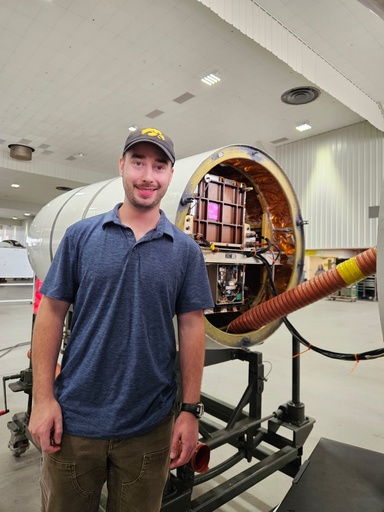
Engineering PhD student Grant Finneman is participating in a NASA field mission this summer, in a way that very few students will ever experience. He is part of a NASA project that is collecting data to better understand dangerous wildfire-generated pyrocumulonimbus clouds (called pyroCb). The INjected Smoke and PYRocumulonimbus Experiment (INSPYRE) is focused on understanding the fire and meteorological conditions that combine to generate pyroCb and the effects of pyroCb on the atmosphere.
Finneman and team are stationed in Great Falls, Montana, a central location for studying fires from southern Canada through the western United States.
It’s highly uncommon for a student to experience a large, coordinated field campaign, and Finneman gets to see both the hardware and software sides. “I’m involved with both the hardware implementation and the data science behind the software side of things,” Finneman said. “I'm looking forward to seeing all the ins and outs from start to finish.”
Ultimately, understanding the pyroCb generated by intense fires means better safety for firefighters and better strategy for fighting these fires. Some wildfires are so intense that they actually generate their own weather, so to learn about pyroCb formation and impacts, researchers fly sensors above the clouds.
The Iowa team relies on the Cloud Physics Lidar (CPL), an instrument mounted to NASA’s unique ER-2 high-altitude research aircraft (pictured above), to collect data. Matthew McGill, PhD, professor of chemical and biochemical engineering, is leading the CPL operations — an instrument that he originally developed 25 years ago while at NASA. The team recently expanded its capabilities, including the ability to transmit data in real time using satellite downlink.
The CPL collects data such as the height, structure, composition, and location of clouds and smoke plumes. The ER-2 aircraft flies above 94 percent of the Earth's atmosphere — so high that the pilots are considered astronauts and wear a space-like compression suit.

Finneman, along with graduate students Jackson Begolka and Sabrina Vlk, are immersed in the day-to-day work with the primary goal of ensuring the CPL is working properly. They interact with the flight crews, maintenance crews, and the scientists who dictate the data collection requirements, then retrieve and process the data.
“This is a very unique opportunity for our students, as there are very few instruments like this,” said McGill. “Students learn first-hand how engineers and scientists work together to accomplish a shared mission, something most students don’t get to experience.”
All of this data informs the forecasting models used to forecast fire conditions, emissions, and the movement of smoke — all of which are used in flight planning. This aspect of the project is led by Greg Carmichael, PhD, Karl Kammermeyer Professor of Chemical and Biochemical Engineering, and Jun Wang, PhD, professor and chair of the Department of Chemical and Biochemical Engineering. The principal investigator of the entire INSPYRE project is David Peterson, PhD, of the U.S. Naval Research Laboratory, who now holds an appointment at the University of Iowa.
Added Finneman: "I could not have imagined this experience being better or possible anywhere else other than Iowa. This experience working with McGill and his lab on this project has been amazing.”

Learn more about the INSPYRE project.