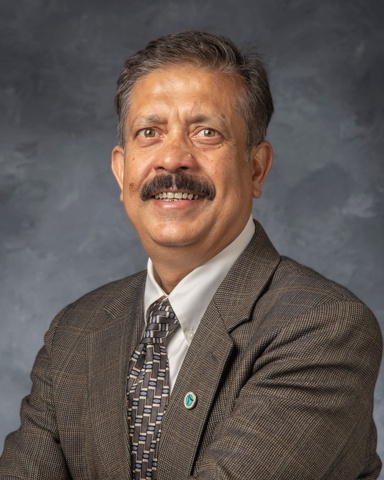
Pranav Saha, professor of electrical and computer engineering, was featured in the April 2026 edition of the International Association of Pattern Recognition (IAPR) newsletter. Saha was inducted as an IAPR fellow for contributions to digital topology and geometry and their application in 2016.
The newsletter is available online and the article about Saha can be found on page 16.
From the newsletter:
Pranav Saha received his Ph.D. from the Indian Statistical Institute and is currently a professor at the University of Iowa. He is a fellow of IEEE, AIMBE, and IAPR. His contributions have been recognized with several major honors, including the Distinguished Investigator Award from the U.S. Academy for Radiology and Biomedical Imaging Research (2021). He has served as an associate editor for multiple international journals and has been actively involved in professional service, including membership on fellow selection committees for both IEEE and AIMBE.
I began my academic journey in a rural school in West Bengal, India. Although resources were limited, the dedication, sincerity, and genuineAlthough resources were limited, the dedication, sincerity, and genuine care of my teachers more than compensated for the lack of facilities.care of my teachers more than compensated for the lack of facilities. Their commitment helped build a strong analytical foundation in theirTheir commitment helped build a strong analytical foundation in their students and instilled in me a deep appreciation for learning andstudents and instilled in me a deep appreciation for learning and independent thinking.independent thinking.
My formal research journey took shape when I joined the Indian Statistical Institute, Kolkata, for my Ph.D. studies. My doctoral work Statistical Institute, Kolkata, for my Ph.D. studies. My doctoral work focused on digital topology and geometry, where I developed thefocused on digital topology and geometry, where I developed the theory for characterizing topology preservation in three dimensions andtheory for characterizing topology preservation in three dimensions and introduced an efficient computational method that continues to be widelyintroduced an efficient computational method that continues to be widely used today. This foundational work was further expanded to classify localused today. This foundational work was further expanded to classify local topological structures, such as plates, rods, junctions, and edges, withintopological structures, such as plates, rods, junctions, and edges, within medial surface representations of three-dimensional digital objects.medial surface representations of three-dimensional digital objects.