
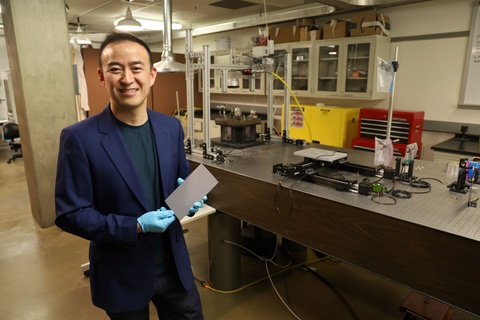
A University of Iowa engineering professor’s research in laser-based manufacturing technologies – aimed at improving how materials are produced for industries such as aerospace, transportation, and automotive – has recently led to five newly issued or pending U.S. patents.
Over the past decade, Hongtao Ding, professor of mechanical engineering, has introduced several laser-based techniques designed to increase speed, efficiency, and flexibility in materials processing. Whether to improve a jet turbine blade, an electric vehicle battery, or metal produced on the Moon, Ding is building technologies designed to move from laboratory demonstrations to real-world application.
“Laser technologies are uniquely positioned to shape the next generation of manufacturing,” said Ding, a faculty affiliate of the Iowa Technology Institute. “Our goal is not only to invent new processes, but to develop methods that the world can actually use.”
10,000 times faster solution
One of Ding’s most recent patents is to protect a method called laser-based high-throughput surface nano-structuring (nHSN). The nHSN method generates large-area superhydrophobic surfaces, often referred to as “engineered dry skins,” which repel water and ice and offers promise for aerospace, automotive, maritime systems, and transportation.
A key achievement in this method is the speed at which it occurs. The effective scanning rate can be up to 10,000 times faster than conventional laser surface texturing techniques, according to the research team.
Ding’s team uses the lasers as a high-speed scanning system that sweeps across metal surfaces. When paired with chemical processing, the method forms dense nanoscale structures over large areas of metal, which could make this technique scalable and feasible for industrial use.
Avik Samanta, Ding’s former PhD student and now an assistant professor at the University of South Florida, led much of the research behind the discovery. Scott Shaw, a UI chemistry professor, helped uncover and explain the fundamental chemistry behind the process.
Three additional patents have been built off the laser processing platform.
- Maskless patterning of metal alloys allows engineers to control how liquids interact with large-area metal surfaces. This laser-based approach can create areas that either attract water or repel it without using masks, lithography, or chemical coatings.
- Transparent conducting terahertz metamaterials are structures designed to manipulate terahertz electromagnetic waves. These materials may support future technologies in sensing, imaging, and security applications.
- Laser-enabled edge coating (LEEC) is a pending technology aimed at improving electric vehicle battery production. Battery components often require dielectric coatings along their edges, a process that can involve several coating and curing cycles. The LEEC approach uses a laser process that could complete the coating in a single step, reducing manufacturing time.
Turning moon dust into metal
An ambitious patent-pending project called laser-assisted synthesis from ore reduction (LASOR) is a hydrogen-fueled, laser-driven process that enables 3D printing of metal parts directly from ore powders. The method integrates additive manufacturing with in-situ reaction flows, allowing metal to form during printing. Conventional metal 3D printing machines typically avoid chemical reactions, making this a bold new direction in advanced manufacturing.
“This represents a major breakthrough for green steel and a transformative idea for in-situ resource utilization on the Moon or Mars, where raw ores are abundant and manufacturing tools must be compact, energy-efficient, and chemically versatile,” Ding said.
Albert Ratner, UI professor of mechanical engineering, has contributed analysis of how hydrogen reduction reactions behave under intense laser heating.
Collaboration and training
Ding’s work includes collaborations with national laboratories such as Pacific Northwest National Laboratory and Oak Ridge National Laboratory, as well as industry partners including General Motors, Samsung Electronics, and Tesla. His research has also received support from the U.S. Army, U.S. Navy, U.S. Department of Energy, and the National Science Foundation.
In addition to research, Ding’s lab trains graduate students in advanced manufacturing and technology commercialization. Many students participate in prototype development, patent applications, and industry partnerships while completing their degrees.