
The University of Iowa College of Engineering is helping drive a major new NASA experiment to better understand the fastest-growing natural disaster hazard in North America: extreme wildfires and the towering storm clouds they create.
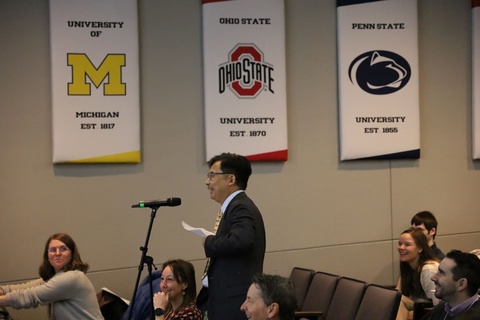
Iowa recently hosted an international team of 90 scientists, engineers, and research partners for NASA’s INSPYRE (INjected Smoke and PYRocumulonimbus Experiment) kickoff meeting. Over the next five years, this team will study pyrocumulonimbus clouds. These are intense, fire-driven thunderclouds that can inject smoke 10 miles above the Earth’s surface and transport it thousands of miles, affecting aviation and visibility.
“Emissions from these large fires are having an increasing impact on weather patterns and visibility in Iowa each summer and fall,” said Jun Wang, kick off meeting host, University of Iowa chair and professor of chemical and biochemical engineering and associate director of the Iowa Technology Institute. Wang is also the Lichtenberger Family Chair in Chemical and Biochemical Engineering.
“We are deeply grateful to NASA and the project leadership team for selecting Iowa to host this meeting. Successfully convening the meeting on our campus in the middle of February is a testament to the importance of this $30 million project, the dedication of the science team, and Iowa’s collaborative contributions to major national science initiatives.”
The purpose of the three-day summit was to introduce team members, prioritize measurements and modeling, and begin designing detailed flight and sampling plans for upcoming field deployments. The group sought to define “flight modules” to guide aircraft operations as early as this summer.
“Some of the best science that is going to come out of this will be cross team collaborations,” said David Peterson, the principal investigator and research meteorologist with the U.S. Naval Research Laboratory. Peterson is also Wang’s former PhD student.
Hosting the meeting underscores Iowa’s growing leadership in Earth and atmospheric sciences.
Kevin Kregel, UI executive vice president and provost, traced the institution’s legacy with NASA back more than six decades, from James Van Allen’s pioneering space physics work to today’s Earth-observing missions. In recent years, the university has strategically expanded its focus on air quality, aerosols, and climate dynamics, he said.
“Fire science and atmospheric modeling align naturally with the strengths we have at this university,” Kregel said. “It's no surprise that two University of Iowa led teams have been selected to contribute to INSPYRE.”