
Curriculum and degree requirements
GLEAM fellows will follow the degree requirements for PhD candidates mandated by College of Engineering and/or the Graduate College, requirements specific to their engineering major, and GLEAM-specific additional requirements that do not add additional efforts but prepare the fellows for success in their advanced manufacturing focus area and professional careers.
College of Engineering and Graduate College requirements for all engineering PhD students include the 1-credit Engineering Ethics course (ENGR:7270) and satisfactory passing of the qualifying, comprehensive, and PhD defense examinations. A doctorate in the College of Engineering requires a minimum of 72 semester hours in courses (including research credits) approved for graduate credit. A PhD candidate must maintain a minimum GPA of 3.25 to be in good standing and at the time of graduation.
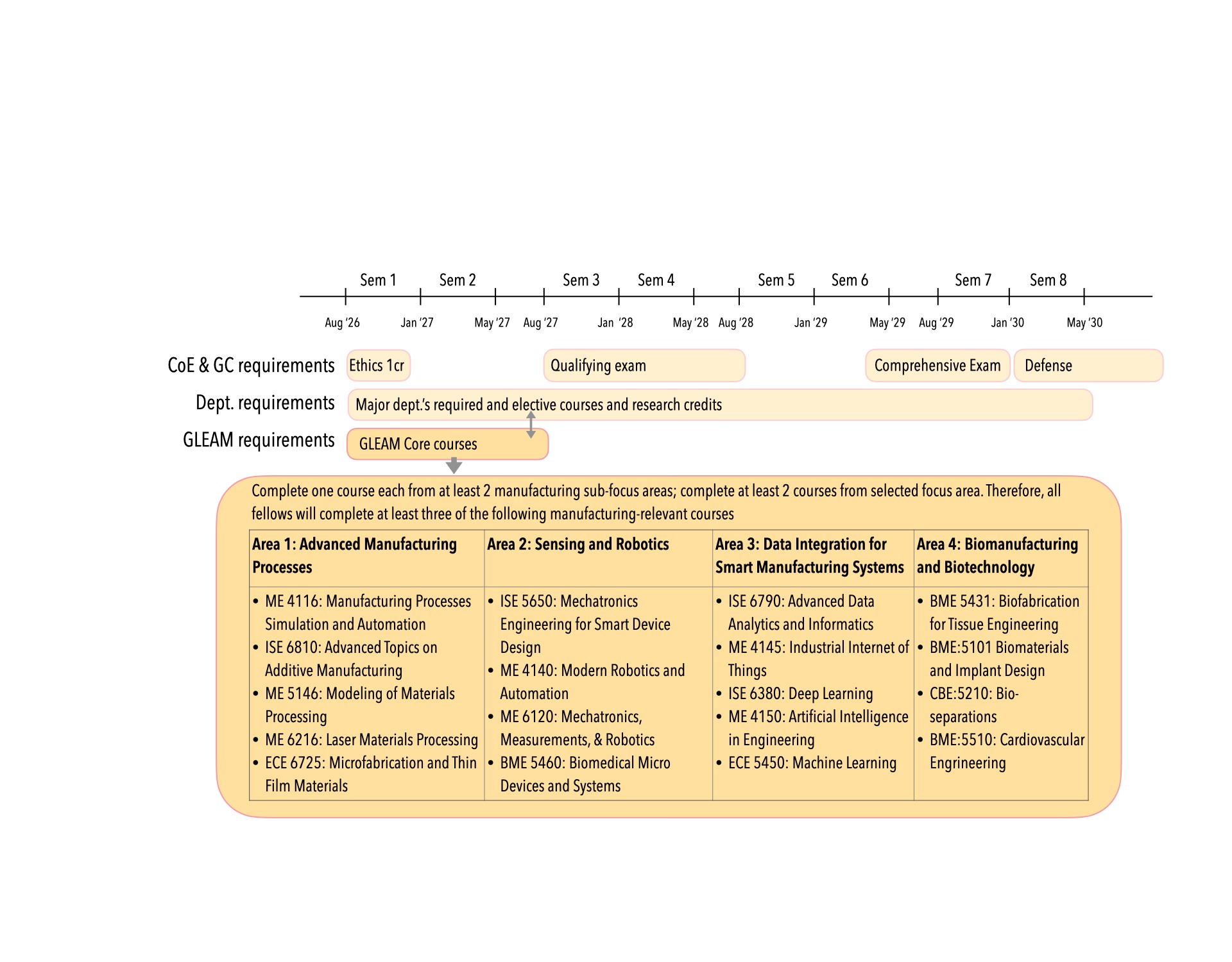
The qualifying examination (QE) required by College of Engineering seeks to assess whether the candidate is ready to begin their graduate research. Departments have different methods of performing this assessment, from conducting written examinations on core topic areas in the major to research-topic specific oral examination by a QE committee of departmental faculty. In all cases, when a student fails to pass the QE (QE pass/fail policies are made available to students), they get one additional attempt to take the QE within a year. If they fail the QE a second time, they are dismissed from the PhD program. In the unlikely event that a GLEAM fellow fails the QE twice, they will be provided the opportunity to switch to one of our MS degree programs
The comprehensive examination (CE) required by the Graduate College seeks to assess the PhD candidate’s readiness to pursue their dissertation project to completion. The candidate is expected to propose their dissertation project aims with adequate background, preliminary data, and planned future studies through both a written report and an oral presentation. Evaluated by an examination committee of at least four faculty members with adequate expertise, the candidate is voted to pass (no more than 1 fail vote) or fail (more than 1 fail vote). Committees may also pass conditionally by requesting specific modifications of the proposed project plan. The examination committee will specify in writing the deadline by which the student must fulfill these requirements. The comprehensive examination may be repeated once at the discretion of the examination committee.
The final examination, sometimes referred to as a thesis or dissertation defense, is a critical inquiry into the purpose, methods, and results of the dissertation research and may include intensive examination in areas related to the investigation. Its policies and procedures are publicly available on the Graduate College website. Administered by the candidate’s examination committee from the CE, the final examination consists of an oral presentation by the candidate of their research project, with a typical uninterrupted presentation length of approximately 20-40 minutes, although committee members may interrupt the presentation to ask questions. They are open to the public. The examination committee members may vote as satisfactory or unsatisfactory. Two or more unsatisfactory votes constitute a ‘fail,’ and the examination may be repeated at the discretion of the examination committee.
Department-specific requirements for PhD candidates include the core courses that all candidates in the department are expected to complete, limitations on elective courses, minimum cumulative GPA, course- specific policies on acceptable grades, and minimum number of courses and research credits. These tend to vary by department. GLEAM fellows will follow all department-specific policies.
GLEAM-specific requirements will fit within the core or electives for any College of Engineering department and hence will not require additional efforts by GLEAM fellows compared to any other PhD candidate in the college. Each fellow is required to complete at least one course each from two of the four topical areas and take at least two courses from a selected focus area (thus at least three total courses from the list of 18 advanced manufacturing-relevant courses). The topical areas and courses are as follows:
- Area 1: Advanced Manufacturing Processes
- ME:4116 Manufacturing Processes Simulation and Automation
- ISE:6810 Advanced Topics on Additive Manufacturing
- ME:5146 Modeling of Materials Processing
- ME:6216 Laser Materials Processing
- ECE:6725 Microfabrication and Thin Film Materials
- Area 2: Sensing and Robotics
- ISE:5650 Mechatronics Engineering for Smart Device Design
- ME:4140 Modern Robotics and Automation
- ME:6120 Mechatronics, Measurements, & Robotics
- BME:5460 Biomedical Micro Devices and Systems
- Area 3: Data Integration for Smart Manufacturing Systems
- ISE:6790 Advanced Data Analytics and Informatics
- ME:4145 Industrial Internet of Things
- ISE:6380 Deep Learning
- ME:4150 Artificial Intelligence in Engineering
- ECE:5450 Machine Learning
- Area 4: Biomanufacturing and Biotechnology
- BME:5431 Biofabrication for Tissue Engineering
- BME:5101 Biomaterials and Implant Design
- CBE:5210 Bio-separations
- BME:5510 Cardiovascular Engineering
Ultimately, the PhD degree is granted primarily based on achievement rather than on the accumulation of semester hours of credit. Excellence in research is the principal requirement for the PhD degree. It is expected that the PhD dissertation research project represents an original and significant contribution to the body of knowledge in the field. While not necessarily a requirement for graduation, it is expected that GLEAM fellows will publish at least one accepted research article as first author, with the research advisor as a co-author, in a peer-reviewed journal, in addition to presentation of their research in a departmental seminar. Submission of more journal articles and at least one research presentation at a national conference are typical.