
In 2025, engineering students reported 120 professional experiences with 63 unique employers. While these numbers reflect only self-reported data, they underscore the hands-on learning that is shaping students.

“For our engineering students, internships and co-ops aren’t just about getting a job; they’re about discovering what kind of engineer they want to be,” said Kalindi Garvin, director of Engineering Career Services. “These experiences give them confidence, clarity, and a sense of purpose before they even graduate.”
Garvin organizes the “employer of the week” program and has led 100 students on nine “career treks” across the Midwest, creating real connections between students and employers.
The treks allow students to explore pre- and post-graduation opportunities in different cities. Students tour companies and meet with local alumni and recruiters. Meanwhile, the employer of the week spends time in the Seamans Center, interacting with students through table displays, workshops, and informational sessions.
What's the difference between a co-op and an internship?
A co-op is typically a longer-term, paid work experience that relates to the student’s academic major, often part of a formal program between employer and institution.
An internship is usually a short-term, often part-time position in which the student gains practical experience in a field. It may be paid or unpaid and is typically informal.

Coding from ocean to sky
Star Tammes, a PhD candidate studying chemical and biochemical engineering, interned at the NASA Ames Research Center at Moffett Federal Airfield in California's Silicon Valley. Tammes, who is from Elgin, Illinois, wrote software for SeaSTAR, a sun-tracking photometer that measures aerosols over oceans — critical for understanding climate and air quality. Field testing aboard NOAA’s R.V. Shearwater combined science with unforgettable moments.
“We were bouncing along the waves, keeping the instrument locked on the sun, and suddenly surrounded by dolphins,” Tammes said.

Designing accessible infrastructure
Thomas Blair, a civil engineering major from Dubuque, Iowa, completed an internship with MSA Professional Services, balancing office design work with on-site observations. He contributed to ADA-compliant sidewalk plans and soccer field layouts using Civil3D, while visiting six active projects, including residential developments and road reconstructions.
“The support from my coworkers made all the difference,” Blair said. “They helped me through challenges and made the experience enjoyable.”
Internship leads to job
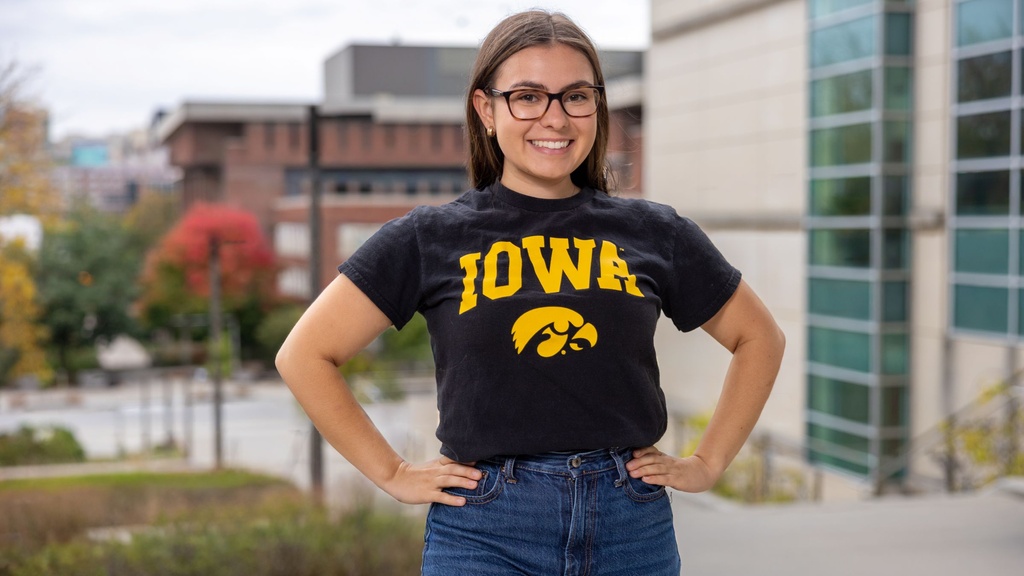
Juliann Pawlowski, a first-generation student from Plainfield, Illinois, worked as a manufacturing engineering intern for a medical device design and manufacturing company in Michigan, the summer after her second year. The internship was made possible through a Hawkeye Experience Grant. The following summer, the biomedical engineering major was a process engineering intern at Procter & Gamble, where she learned about making toothbrushes. That experience turned into a post-graduation role as a manufacturing engineer at Procter & Gamble in Iowa City for Pawlowski, who graduated in May.
“Iowa offers so many opportunities,” Pawlowski said. “Wherever you set your horizons, you can reach them at Iowa.”

Never stop learning
For Sydney Williams, a first-year master’s student in electrical and computer engineering, internships have been transformative. At Skyworks Solutions, the Cedar Rapids native worked on RF electronics for mobile devices — designing multi-chip modules, troubleshooting coupling issues, and performing lab tests for S-parameters and ruggedness. Williams now uses industry experience as a teaching assistant, helping integrate Cadence tools like OrCAD and PSpice into Iowa’s curriculum.
“My top takeaway? Never stop learning,” Williams said.