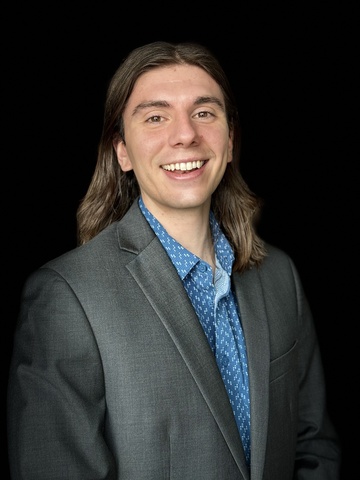
Since beginning his undergraduate studies in 2016, Zachary Althof has been deeply involved in advancing biomedical imaging research at the University of Iowa. Now a fourth-year PhD candidate in biomedical engineering, Althof works in the Reinhardt Biomedical Imaging Lab, where he has developed a deep learning method to quantify and visualize pulmonary inter-lobar fissure integrity from thoracic CT scans. His research investigates the role of fissure integrity in lung biomechanics and its connection to diseases such as COPD.
What inspired you to pursue a graduate degree in biomedical engineering?
I started out doing undergraduate research in the Reinhardt Imaging Lab. I loved the work being done there and when presented with the opportunity to get into the fast-track
program and start work on my masters during my final year of undergrad it felt like too good of an opportunity to pass up. After that I was able to get funding to pursue my PhD and
further the bioimaging research.
Why did you choose this particular university and program?
I knew I wanted to study biomedical engineering. It was the perfect blend of my interests in engineering and medicine. University of Iowa is one of the best BME schools with the added bonus of not being too far (or too close) to my hometown! I started in mechanics/materials, but once I took EPS II, I fell in love with coding and switched to the bioimaging track.
What professor do you primarily work with?
Joseph Reinhardt, PhD
What is your current research focus or thesis topic?
I am studying how pulmonary fissures impact lung biomechanics, particularly in COPD. To
do this I develop deep learning models to segment, quantify, and classify data from
medical images (particularly thoracic CT).
What has been the most exciting or challenging part of your research so far?
The most challenging part of my research is the unpredictability of deep learning model
development. Some methods, architectures, and pipelines will work well in certain fields,
but perform poorly on other tasks. Identifying the proper networks and training paradigms
for the task at hand can be a significantly laborious and complicated issue. However, when
you finally find a setup that works, it feels like magic!
Who has been an influential or inspiring person during your time in engineering at
Iowa?
Dr. Reinhardt has been the most supportive, encouraging, and knowledgeable mentor
anyone could ask for. I was just a young, naïve undergrad when I emailed him to talk about
his research. I am incredibly grateful to have been given an opportunity to start my research
in his lab and learn from Dr. Reinhardt and Dr. Sarah Gerard.
What are you interested in pursuing after graduation?
I hope to go to industry and develop cutting edge deep learning tools to aid doctors in
diagnosis and improve patient care and outcomes.
What are your hobbies or interests outside of your academic work?
I love to stay active; gym, hiking, and walking the dog are where I do some of my best
ideating for my research. Volleyball and golf are great in the summer, and I must admit I do
my fair share of gaming as well.