
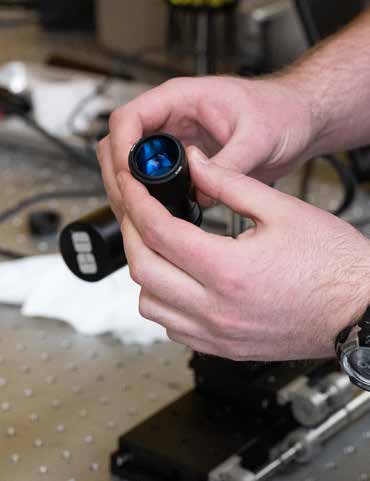
Matthew McGill works with a student at the Iowa Atmospheric Sensor Development Laboratory.
CBE professors have turned P3 seed funding into $9.4 million in NASA grants.
The University of Iowa’s P3 grant program has had a transformative impact on Earth observation research in the College of Engineering, leading to faculty hires, new graduate students, critical infrastructure, and external funding, including nearly $10 million in recent NASA awards.
Funded through Iowa’s utility public-private partnership, the P3 program supports strategic campus initiatives. One of the program’s earliest and largest investments was $3.6 million in 2021 to expand space-based research across the university.
“The P3 program provided us the opportunity to invest in one of Iowa’s core strengths and build interdisciplinary partnerships that capitalize on our legacy of space research,” said Kevin Kregel, executive vice president and provost. “The enhanced infrastructure and resources for our talented researchers provided the launchpad for Iowa to be a national leader in Earth and lunar science instrumentation.”
This fall, NASA’s Instrument Incubator Program awarded two grants totaling nearly $10 million to College of Engineering professors, marking a significant step in the development of a collaborative research environment that leverages expertise across engineering, physics, and environmental sciences at Iowa.
Jun Wang, DEO and professor of chemical and biochemical engineering, Lichtenberger Family Chair in Chemical and Biochemical Engineering, and assistant director of the Iowa Technology Institute (ITI), is leading a three-year, $4.9 million grant.
The project's focus is developing a space instrument to probe how tiny particles in the air known as aerosols are distributed three-dimensionally across the world, influencing cloud, weather, and climate patterns. Wang’s team is developing algorithms to interpret data from the instrument, which will be built in collaboration with NASA’s Jet Propulsion Laboratory.
“We are deeply grateful for the university’s P3 program investment, the College of Engineering’s support, and the visionary guidance of our leadership,” Wang said. “Their contributions have been instrumental in shaping and advancing our strategy for growth and excellence in education and research, particularly in the observation and study of Earth and its atmosphere.”
Matthew McGill, professor of chemical and biochemical engineering and a faculty affiliate of the ITI, is leading the other grant. The three-year, $4.5 million project will develop a cost-effective way to measure changes in the Earth’s lower atmosphere by gathering data about how aerosols, clouds, and the planetary boundary layer change throughout the day. McGill’s project will utilize infrastructure developed as part of the P3 project to expand space-based research.
These recent grants highlight the far-reaching impact of the P3 project, which supported the development of sensors, algorithms, and testing capabilities to elevate the role Iowa can play in future NASA missions. The initiative also made it possible for the College of Engineering to recruit McGill, an expert in instrument development with 25 years of experience at the NASA Goddard Space Flight Center.