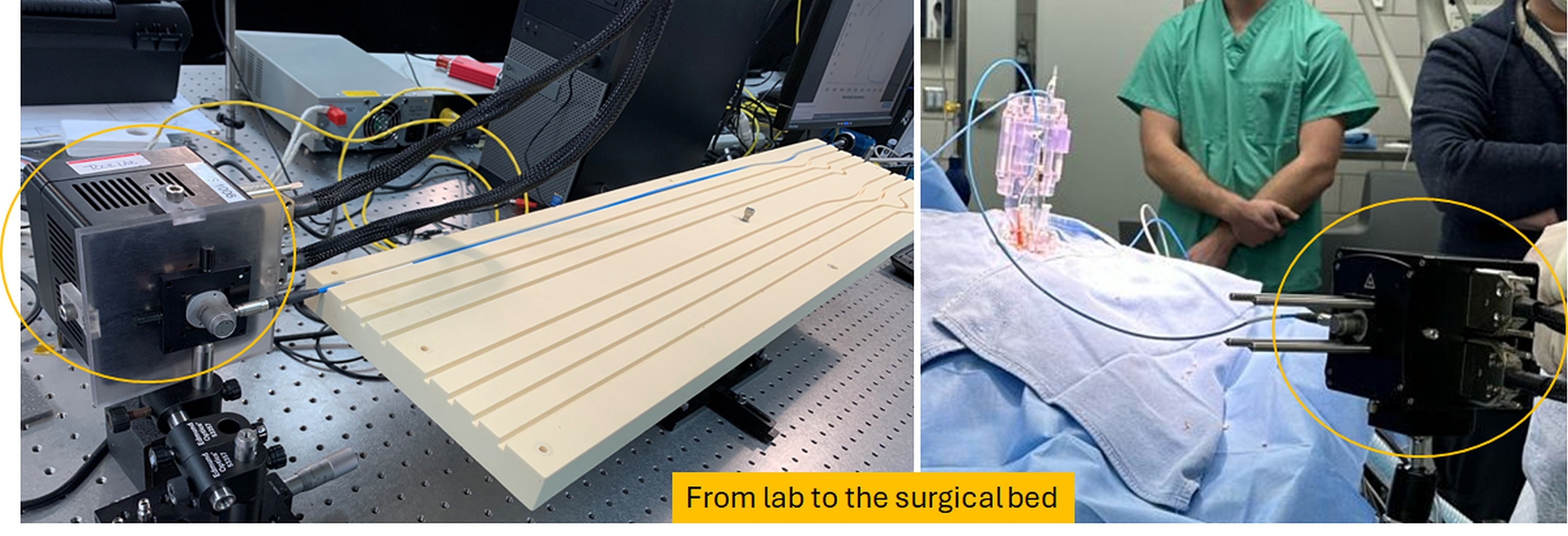
Researchers at the University of Iowa have found they can bend high-tech lasers without sacrificing performance – a key milestone in bringing advanced laser systems into hospitals, labs, and fieldwork. This finding could ultimately protect patients, improve diagnostics, and expand scientific capabilities.
The scholars have published their findings in Applied Optics, a journal of peer-reviewed optics and photonics research.
The research team includes Daniel W. Keefe, a 2024 PhD who is now a biomedical device engineer at Juggernaut Life Sciences, Inc.; Fatima Toor, Lowell G. Battershell Chair in Laser Engineering and professor of electrical and computer engineering; and Sandeep Laroia, an interventional radiologist at UI Health Care.
The research explores how well certain types of optical fibers perform when bent—an important consideration for real-world uses like minimally invasive laser surgery and chemical sensing.

Using a high-powered mid-infrared laser and four types of fluoride glass fibers, the team tested how bending affects the fibers’ ability to carry light. They found that bending the fibers within manufacturer-recommended limits does not significantly reduce performance. Even sharp bends only caused issues in one fiber type—and only when bent more than recommended.
These findings were confirmed through both hands-on experiments and advanced computer modeling. This research supports the development of flexible, high-performance laser tools that can be safely used in tight or complex environments, such as inside the human body.