
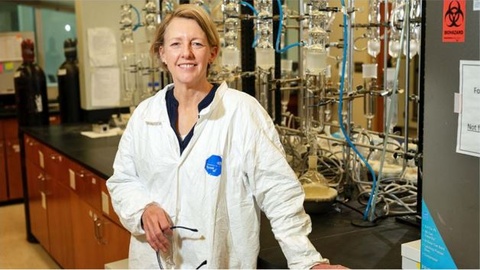
Years of work by University of Iowa (UI) College of Engineering researchers have been rewarded with a new round of federal funding, a sign of progress in the battle against a lingering environmental threat known as polychlorinated biphenyls (PCBs). These toxic chemicals, once widely used in construction materials and industrial products, continue to pose health risks decades after their ban.
The Iowa Superfund Research Program (ISRP), a nationally recognized center of excellence led by Keri Hornbuckle, UI Distinguished Chair and professor of civil and environmental engineering, is zeroing in on airborne PCBs. Recent findings by the program suggest that inhalation may be the most significant route of human exposure to PCBs, presenting an especially urgent problem.
The National Institutes of Health recently gave a vote of confidence to the ISRP in the form of a $2.8 million renewal grant that is expected to reach $15 million through 2030.
The Iowa Superfund Research Program is looking to partner with communities and school districts around Iowa to examine exposure to PCBs in its facilities. To learn more about the program, contact keri-hornbuckle@uiowa.edu.
The team’s focus now is PCB emissions in schools and from contaminated soils and waters. The investigators aim to understand how these chemicals impact adolescent neurodevelopment and metabolism, with the goal of crafting strategies to reduce exposure and improve community health.
Key efforts include developing community-supported remediation strategies, investigating the toxicity of lower-chlorinated PCBs during adolescence, and designing cost-effective methods to detect and reduce airborne PCBs in school buildings. The team will also study emissions from dredged sediments and explore microbial solutions to break down PCBs in contaminated environments.
The multi-disciplinary research team also includes Hans Lehmler, James Ankrum, Aloysius John Klingelhutz, Xueshu Li, Rachel Marek, Andres Martinez, Timothy Mattes, Kai Wang, and Shannon Lea Watkins.