
Students' passion fuels opportunity to put engineering into practice
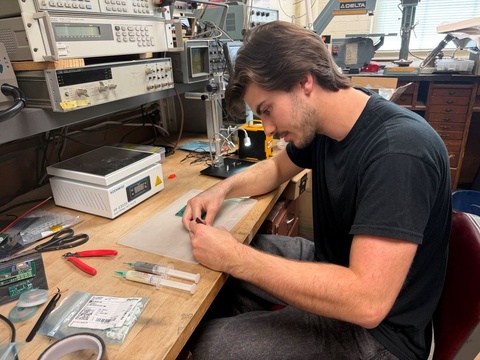
Rocketry and aerospace have long fascinated Sam Manley. The undergraduate studying electrical and computer engineering at the University of Iowa brought those interests to life. Manley has been one of the leaders behind a student team building a competition-worthy, high-powered rocket.
The effort has been a technical challenge and a powerful learning experience.
Building the rocket has pushed students to apply coding, mechanics, circuitry, and teamwork in real time. Concepts that can feel abstract in the classroom take on new meaning in the workshop, often giving students a head start in courses such as Embedded Systems and Computer Architecture.
“In order to write good software, you have to know the hardware underneath,” said Manley, a rising senior from Rockford, Illinois.
At the end of the previous year, only five students were involved in the Aerospace and Rocketry Club. “We looked around and said, ‘We need more people,’” Manley said.
Recruiting became the top priority, and the group’s enthusiasm proved contagious. Within months, five students grew to 35. Support from an Iowa Space Grant Consortium grant for aerospace and STEM learning helped turn their plans into reality.
In a basement workshop in the Chemistry Building, students from across engineering disciplines printed and soldered circuit boards, embedded GPS systems, wrote flight software, and designed custom sensors.
“This has been a great place to learn the design process,” said Jason Grinstead, a first-year mechanical engineering student from Montgomery, Alabama. “I like how much of this project is practical and hands-on.”
Grinstead worked with River Gehling, a chemical and biochemical engineering undergraduate from Kalona, Iowa, on designing the rocket’s fins. Gehling said the experience highlighted the value of collaborating across disciplines.
By year’s end, the team had built a five-foot rocket ready for the Midwest High-Power Rocketry Competition in Minnesota. The rocket would control its roll midflight, log custom sensor data, and decode a flashing “secret message” using a down-facing camera.
“We took something without a blueprint,” Manley said, “learned through trial and error, and built a system that worked.”