Alumni support leads to new distillation column to enhance learning in CBE lab.
A new laboratory-scale distillation column is transforming how chemical and biochemical engineering students engage with complex chemical processes, a fundamental skill for their future careers.
Typically, students would learn on paper, running calculations to understand the process of separating liquids. The distillation column brings the process to life.
“Some students are really overwhelmed by separating liquids because it looks complicated,” said Bram Sueppel, a 2025 chemical engineering graduate from Iowa City who served as a teaching assistant. “Once you start working hands-on with the distillation column, students are surprised how quickly they understand.”
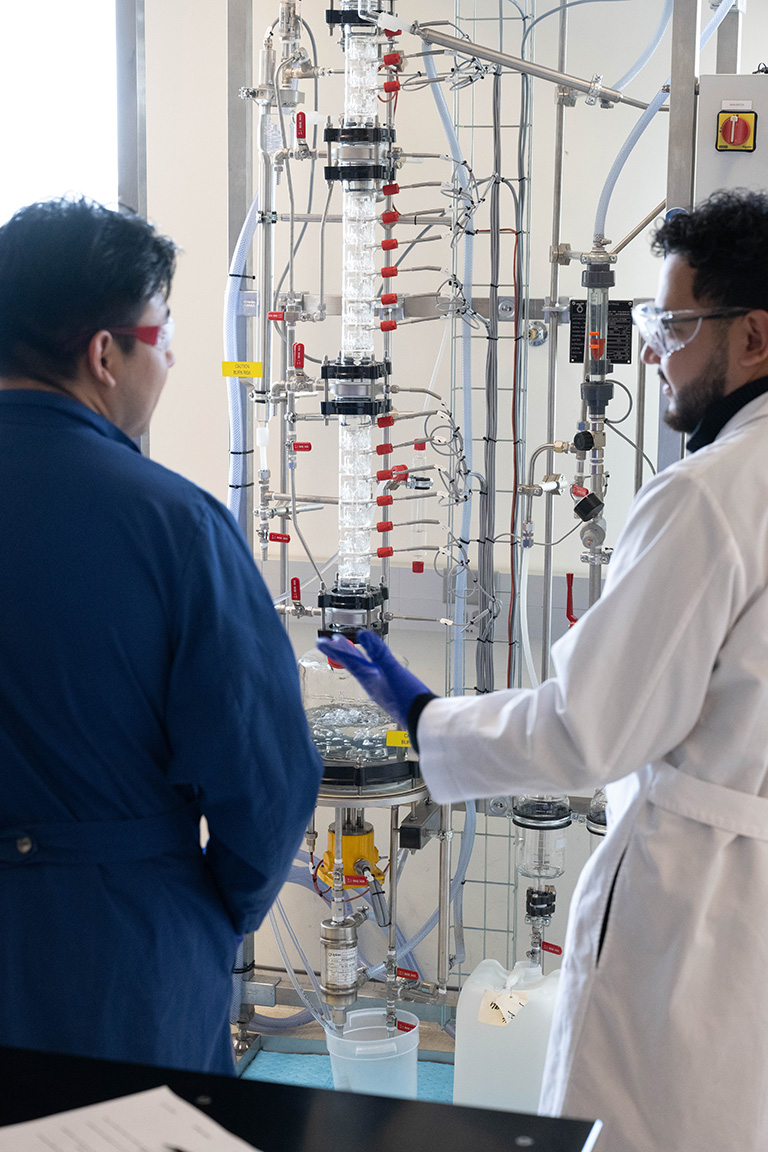
The cylindrical structure is made up of coiling tubes and trays or packing material that facilitates the separation process. CBE’s distillation column stands six feet tall and is glass-sided to allow students to visualize the process, while industrial columns can be multiple stories tall and the mechanics are hidden by steel casing.
Distillation columns are used to separate liquid mixtures based on differences in their vapor pressure, or boiling points. This process is essential in various industries, including petrochemicals, pharmaceuticals, and food processing, as it allows for the efficient separation of liquids into their individual components.
Without distillation columns, these industries would struggle to produce pure substances necessary for their products and processes, such as separating crude oil into usable parts like kerosene, gasoline, and diesel.
“We are so excited for the students to use this new column. It significantly enhances our laboratories,” said Beth Rundlett, a chemical and biochemical engineering professor of practice who teaches topical courses including chemical reaction engineering and separations.
The new Pignat distillation column stands out due to its innovative, completely see-through design. This unique feature enables students to observe the inner workings of the column in real time, making the intricate concepts of separation much easier to understand.
This visual learning tool empowers students to experiment and observe firsthand, bridging the gap between classroom theory and real-world practice. With this new addition, students are better equipped to dive into the world of distillation and elevate their understanding of chemical processes.
“You can observe a continuous cycle of evaporation, condensation, and separation,” said Carlos Gutierrez, a 2025 CBE graduate from Northlake, Illinois. “You go from learning in two dimensions to three dimensions.”
Since fall 2022, in partnership with the College of Engineering and the University of Iowa Center for Advancement, CBE has spearheaded major upgrades of its teaching labs. Thanks to the generous support of CBE alumni, more than $200,000 has been raised to date for upgrades, including the distillation column.
“On behalf of CBE’s faculty, staff, and students, we would like to extend our heartfelt thanks to our alumni whose generous contributions made our teaching lab upgrade and purchase of equipment such as the distillation column possible,” said Jun Wang, DEO and professor of chemical and biochemical engineering, Lichtenberger Family Chair in Chemical and Biochemical Engineering, and assistant director of Iowa Technology Institute.